Modern Japanese Inheritance Law – Essential Knowledge for International Estate Professionals
Introduction
When handling estate settlement procedures for a decedent who died in Japan, international estate professionals (probate lawyers, estate administrators, genealogists) face the unique characteristics of Japan’s inheritance law system.
Japanese inheritance law has a fundamentally different structure from Western probate systems. Court involvement is generally unnecessary, agreements among heirs are prioritized, and the system is closely tied to the koseki (family register) system. There are many points to understand.
This article explains the basics of Japanese inheritance law that international estate professionals should know when handling Japanese cases.
Basic Structure of Japanese Inheritance Law
Court Involvement Generally Unnecessary
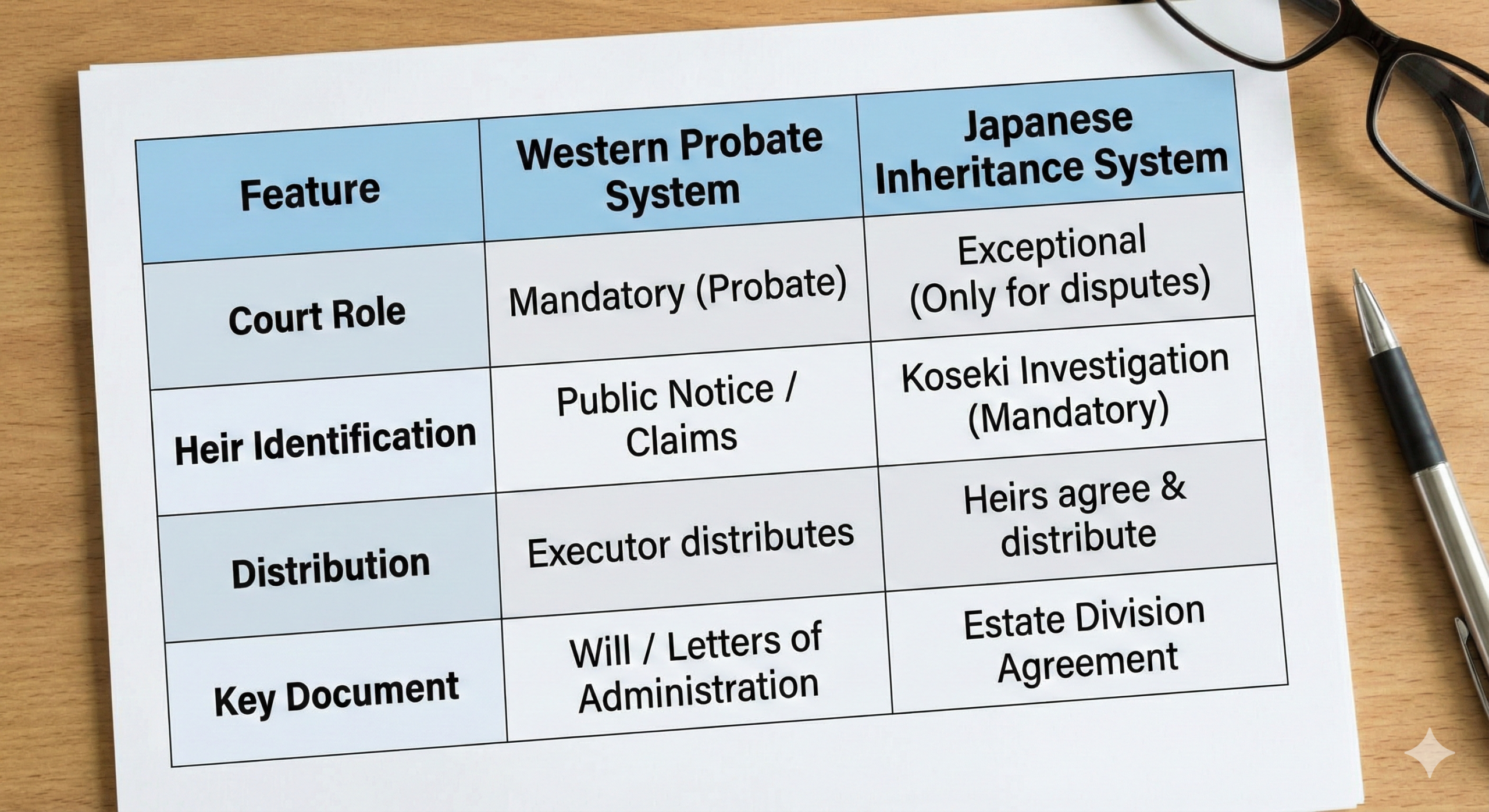
The most distinctive feature of Japan’s inheritance system is that court involvement is generally unnecessary.
In Western probate systems, court procedures such as probate of wills and appointment of estate administrators are often mandatory. However, in Japan, once heirs are identified, estate distribution is completed through negotiation among heirs (estate division agreement).
Courts are involved only in the following cases:
- When estate division agreement cannot be reached among heirs (family court mediation/adjudication)
- Renunciation of inheritance (petition to family court required)
- Probate of wills (only for holographic wills; not required for notarized wills)
- Appointment of estate administrator (when no heirs exist)
Statutory Inheritance System
Under Japanese inheritance law, when there is no will, heirs defined by the Civil Code (statutory heirs) inherit the estate in specified proportions (statutory inheritance shares).
Priority of Statutory Heirs:
First Priority: Spouse + Children (lineal descendants)
- Spouse: 1/2
- Children: 1/2 divided equally
- If a child has already died, that child’s children (decedent’s grandchildren) inherit by representation
Second Priority: Spouse + Lineal ascendants (parents, grandparents)
- Spouse: 2/3
- Lineal ascendants: 1/3 divided equally
- Applied when there are no children
Third Priority: Spouse + Siblings
- Spouse: 3/4
- Siblings: 1/4 divided equally
- Applied when there are no children or lineal ascendants
- If siblings have already died, their children (decedent’s nieces/nephews) inherit by representation (one generation only)
When only spouse, only children, only lineal ascendants, or only siblings: Inherits all
Estate Division Agreement
After heirs are identified, all heirs negotiate the method of estate distribution. This is called estate division agreement.
Characteristics of estate division agreement:
- Agreement of all heirs required
- Distribution different from statutory shares is possible
- Creation of written document (estate division agreement document) is practically essential
- Signatures and registered seal impressions of all heirs required
- Seal registration certificates must be attached
When estate division agreement cannot be reached: Family court mediation/adjudication procedures
Reserved Portion System (Iryubun)
Japanese inheritance law has a system called iryubun (reserved portion). This is the minimum inheritance share guaranteed to certain heirs.
Reserved portion right holders:
- Spouse
- Children (lineal descendants)
- Lineal ascendants (parents, grandparents)
Siblings have no reserved portion
Reserved portion ratio:
- When only lineal ascendants are heirs: 1/3 of estate
- Other cases: 1/2 of estate
Claim for infringement of reserved portion: Heirs whose reserved portion has been infringed by will or other means can claim payment of money equivalent to the infringed reserved portion amount from those who received bequests or gifts (for inheritances beginning on or after July 1, 2019).
Practical Inheritance Procedures
Identification of Heirs
In Japanese inheritance procedures, heirs are identified through koseki transcripts.
Required koseki:
- All koseki transcripts, removed koseki transcripts, and original koseki before reformatting from the decedent’s birth to death
- Current koseki transcripts of all heirs
For details, please refer to the separate article “Why Do Japanese Inheritance Cases Require Multiple Koseki?”
Scope of Inherited Property
Included in inherited property:
- Real estate (land, buildings)
- Movable property (cash, deposits, securities, jewelry, automobiles, etc.)
- Receivables (loans, accounts receivable, etc.)
- Intellectual property rights
Not included in inherited property:
- Life insurance benefits (when beneficiary is designated, generally not inherited property)
- Death retirement benefits (under certain conditions, not inherited property)
- Condolence money
- Ritual property (gravesites, Buddhist altars, etc.; succeeded by ritual successor)
Debts are also inherited: Debts and other liabilities are also subject to inheritance. Heirs succeed to debts in proportion to their statutory inheritance shares.
Renunciation and Limited Acceptance of Inheritance
Heirs can choose whether to accept or renounce inheritance.
Renunciation of inheritance:
- Heir does not inherit any inherited property
- Petition to family court required
- Must petition within 3 months from when one learns of inheritance commencement
- Heir who renounced is deemed never to have been an heir
Limited acceptance:
- Accepting inheritance on condition of paying debts within the scope of inherited property
- All heirs jointly petition family court
- Must petition within 3 months from when one learns of inheritance commencement
- Rarely used in practice
Simple acceptance:
- Unconditionally inheriting all inherited property and debts
- If renunciation or limited acceptance is not made within 3 months, deemed to have simply accepted
Types and Effect of Wills
Japanese Civil Code recognizes the following will formats.
Holographic will:
- Testator writes entire text, date, and name in own handwriting and affixes seal
- Since January 13, 2019, property inventory can be computer-created
- Family court probate required (except when Legal Affairs Bureau custody system is used)
Notarized will:
- Created by notary public
- Requires presence of 2 or more witnesses
- No probate required
- Most reliable format
Secret will:
- Can keep will contents secret
- Sealed before notary public and 2 or more witnesses
- Probate required
- Rarely used in practice
Effect of will: A will takes effect upon the testator’s death. Distribution different from statutory shares is possible through a will, but subject to reserved portion constraints.
Important Points for Probate Genealogists
Key points that international probate genealogists handling Japanese cases should understand:
1. Court Involvement Is Exceptional
In Japan, courts do not generally involve in routine inheritance procedures. A system equivalent to “probate court” exists only when agreement cannot be reached among heirs.
2. Heir Identification Through Koseki
Identifying heirs requires all consecutive koseki from the decedent’s birth to death. “One current koseki” is insufficient.
3. Estate Division Agreement Is Central
Estate division agreement through unanimous consent of all heirs is central to inheritance procedures. All members’ signatures and registered seal impressions are required; procedures cannot proceed if even one is missing.
4. Difficulty of Heir Search
Japan has no public system or profession equivalent to probate genealogists. Investigation when heirs’ whereabouts are unknown requires specialized knowledge and on-site investigation capability.
5. Restrictions on Koseki Acquisition
Persons eligible to request koseki transcripts are limited to the person themselves, spouse, lineal relatives, and agents (power of attorney required). Third parties cannot easily obtain them.
Conclusion
Japanese inheritance law has a fundamentally different structure from Western probate systems. There are many points to understand, including generally unnecessary court involvement, emphasis on negotiation among heirs, and close connection to the koseki system.
Particularly when international probate genealogists or estate professionals handle Japanese cases, it is important to fully understand the unique characteristics of Japan’s inheritance law system and consult Japanese specialists when necessary.
Our institute provides support services for international inheritance cases, including koseki analysis and basic family relationship research. Please feel free to contact us if you encounter difficulties with Japanese inheritance cases.